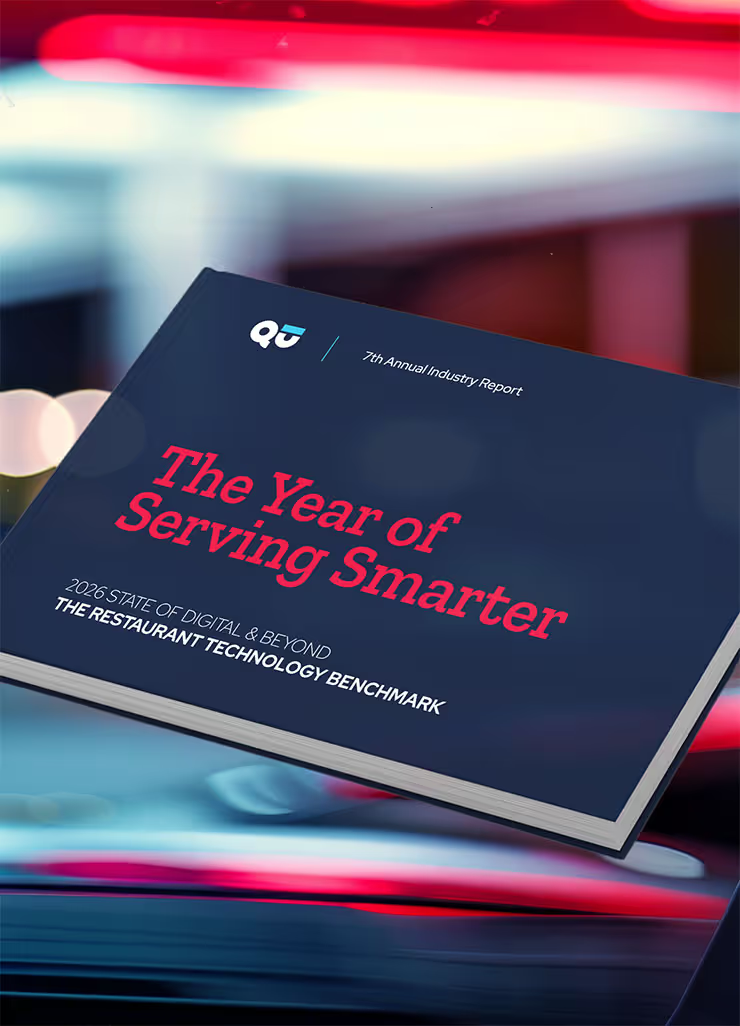
2026 State of Digital & Beyond:
The Restaurant Technology Benchmark
The Year of Serving Smarter
QSR and Fast Casual brands enter 2026 in a more disciplined operating environment. Traffic remains uneven, labor constraints persist, and margins continue to tighten.
The industry has moved from experimentation to execution, defined by operational stability, intelligent decision-making, and a unified guest experience. Brands are focused on optimizing new channels while closing operational gaps.
This year’s survey examines how restaurant leaders are navigating that shift, and where they are investing to improve performance, resilience, and margin control.


Seven Years. Seven Charities.
In honor of our seventh annual industry report, we donated to seven charities supporting causes important to our restaurant participants.





Top 6 Trends in 2026
Guest Experience Leads Spend, Fragmentation Limits Impact
Brands are investing in guest experience, but alignment between systems and operations hasn’t caught up. Operational execution and consistent experiences are top priority to improve. Execution is the bottleneck, not innovation.
Top Tech Investment Areas
- 57% rank Digital Guest Experience as a top investment
- Unified Commerce increased from 14% to 17%
- 41% are investing in POS Modernization
- CDP dropped from 34% last year to 16% this year
Guest Insight Tools
Loyalty remains the primary system of record for guest understanding. Reputation management and business intelligence also play a big role.
Fast Casuals say execution *
QSRs say fragmentation *
Fast Casuals say execution *
QSRs say fragmentation *
Fast Casuals say execution *
QSRs say fragmentation *
Fast Casuals say execution *
QSRs say fragmentation *
48% of Enterprise vs 11%hinders a unified guest experience
Fast Casual operators feel the greatest strain from operational challenges (60%), whereas QSRs more often cite fragmented systems and disparate data (44%), reinforcing the need for aligned operational and technology strategies.
Why Guest Data Matters

Digital Scale Exposes Operational Vulnerabilities
Digital has amplified risk at the core of the operation. In-store POS remains the primary revenue anchor, third-party ordering ranks highest for system instability (35%), followed by first-party ordering (27%).
Top Ordering Channel, in Terms of Total Sales
60%selected in-store POS as the top performing order channel
In-store POS remains the primary revenue driver, while both third-party and first-party ordering contribute meaningfully to overall sales.
Area of System Instability Affecting Brands Most
35%of respondents identified third-party ordering as having the highest instability
This highlights ongoing challenges around integrations, reliability, and operational dependency on external platforms as digital volume
continues to scale.

“As technology evolves, the heart of hospitality remains exactly the same: creating experiences that make guests feel seen, welcomed, and eager to return. The brands that will thrive in this next chapter are the ones that treat technology not as a collection of features, but as a foundation for hospitality and operational excellence.”

AI Moves from “If” to “Where” but Value Lags
AI investment has crossed the tipping point, with 73% of brands investing now or within the year. Outcomes are early, but only 9% note meaningful impact, and 33% report that value is still emerging.
73% of brands are investing in AI.
73% of brands are investing in AI.
73% of brands are investing in AI.
73% of brands are investing in AI.
73% of brands are investing in AI.


AI has moved into active investment: 51% investing today, and another 22% plan to begin in 2026, meaning the majority are “now or this year.” And it’s still early in turning investment into scaled outcomes.
Investing in AI


- Actively Investing : 51%
- Planning to Invest in 2026 : 22%
- No Plans to Invest : 17%
- Planning to Invest in 2027 : 10%
Where AI Spend is Going
AI investment is focused on guest growth first—CRM, personalization, and marketing—followed by predictive operations and voice ordering. QSRs are investing significantly more in front-of-house AI, particularly voice ordering and drive-thru computer vision.
Tech Spend is Increasing Despite Margin Pressures
Investment momentum is notably stronger among QSR brands, with 54% planning to increase spend on new technology in 2026, compared to 44% of Fast Casual restaurants.
This gap suggests QSR operators are accelerating digital and operational investments to remain competitive in a high volume, efficiency driven environment.
Almost half of all brands expect their tech investments to increase in 2026.


- 48% Increase
- 34% Stay The Same
- 10% Decrease
- 9% Unsure
Digital Sales Grow, QSR Momentum Accelerates
Multiple digital channels are now table stakes. Success depends less on piloting new channels or testing flashy point solutions and more on optimizing them while closing operational gaps. Digital focus has shifted from adoption to integration, efficiency, and profitability.
py (2024-2025) comparison
57% of brands generated more than 25% of total sales through digital channels in 2025—an 8 point increase year over year
QSR vs Fast Casual:
Percent of Sales from
Digital Channels
The digital adoption gap is narrowing. QSRs are catching up.
After the digital mix stablized for both segments in 2024, QSRs with digital sales greater than 26% gained 10 points in 2025 (jumping from 23% to 33%). Almost a quarter of Fast Casual brands now report over 40% of their sales come through digital channels.
>26% Digital Sales
11-25% Digital Sales
0-10% Digital Sales
% of total sales from QSR v FC
Macroeconomic Pressure is Driving a Shift Toward Smarter Commerce
Brands have shifted from "growth-at-all-costs" to efficient, margin-focused strategies. Solutions focus on value, menu innovation, operational improvements, and AI, signaling a renewed emphasis on demand stimulation and menu-led traffic growth.
Macroeconomic Conditions with Greatest Impact
Universally, pressure was driven primarily by declining guest traffic, inflation, and rising labor costs in 2025.
Fast Casual vs. QSR:
Macroeconomic Headwinds
Fast Casual brands have heightened pressure around rising costs, and QSRs are feeling price sensitivity from their guests.
Fast Casual
Inflation and labor costs continue to weigh heavily on operators.
 56% of Fast Casuals impacted by inflation
Quick Service Restaurants
Guest price sensitivity increases tension between margin protection & value expectations.
44% of QSRs report heightened pressure around value perception and discounting expectations
How Brands are Responding
Promotions and discounts, along with new menu items and limited-time offers (LTOs) emerged as the most effective strategies for improving both revenue and margins. This highlights operators’ continued reliance on demand stimulation and menu innovation to drive traffic.
Most Effective Strategies for Improving Revenue & Margins
Loyalty fell from the top spot in 2024 to #4 in 2025, which isn't surprising given it's a longer term revenue strategy. Survey responses show, however, that investment in loyalty remains high across the industry.
- Promotions / Discounts
- Loyalty or Rewards Programs
- New Menu Items or LTOs
- Operational Improvements that Reduce Cost or Improve Throughput
- Marketing Campaigns
- Upselling or Bundled Meal Offers
Operational Improvements Planned in 2026
Discounting and innovation can drive traffic, but they also strain operations. As complexity increases, performance becomes a kitchen problem. In fact, 62% of brands say improving order flow across all channels is their top priority for 2026, followed by team workflow (52%) and more accurate ready and pickup times (48%).
Demographics
Survey Methodology
Participation was voluntary and limited to Fast Casual and QSR brands over 20 locations. Respondents completed an 20-question survey via an online survey tool.
74% of respondents are director, VP, and above.
74% of respondents are director, VP, and above.
74% of respondents are director, VP, and above.
74% of respondents are director, VP, and above.
74% of respondents are director, VP, and above.
74% of respondents are director, VP, and above.
74% of respondents are director, VP, and above.
Total number of owned and franchised locations among participants.

- 21 to 100 Sites : 45%
- > 250 Sites : 38%
- 101 to 249 Sites : 16%
Job Level
Job Function

“To effectively address the challenges surfaced in our 2026 report, restaurants need intelligent systems built on unified data. Without that foundation, AI becomes another tool layered onto disconnected systems rather than a true growth engine.”